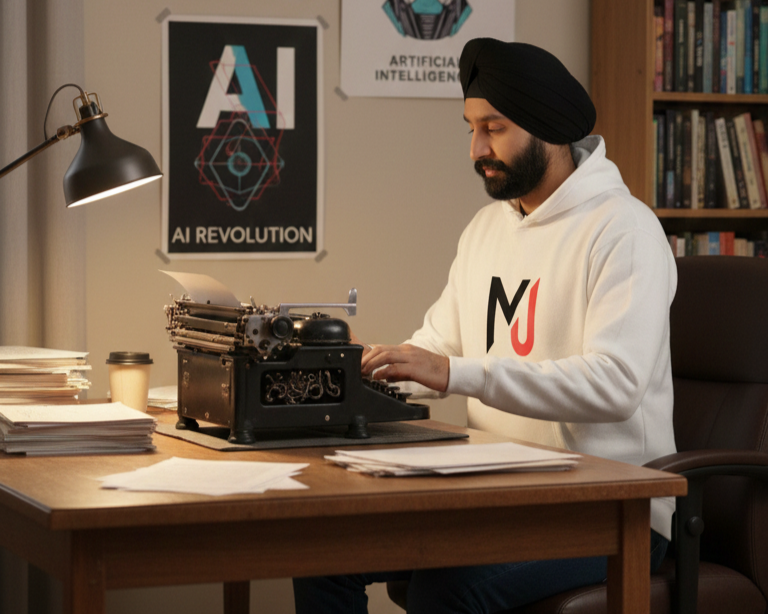
AI can write your LinkedIn post better than you can. So why would anyone read yours?
This is the existential crisis facing every LinkedIn creator in 2026. Generic advice is now infinitely abundant and instantly generated. “5 tips to improve productivity” or “How to build a sales funnel” can be produced by ChatGPT in three seconds, formatted perfectly, optimized for engagement, and completely forgettable.
The LinkedIn experts who are actually building businesses on the platform have identified a fundamental shift: the commodity isn’t expertise anymore. Everyone has expertise. The commodity is authentic, unreplicable personal experience. AI can tell people how to do something. It can’t tell them how you specifically did something, what you learned when it went wrong, and why that matters.
Most LinkedIn users are still playing the old game, competing on information quality in a world where information is free. Meanwhile, the people converting attention into revenue have moved on to an entirely different strategy: treating their profile like a sales funnel, their DMs like text messages, and their content like a personal documentary rather than a knowledge base.
Here’s what actually works now.
“How-To” Is Dead, “How-I” Is the Only Thing That Matters
The new rule for content in 2026 is simple: if AI can write it, you shouldn’t post it.
Generic “How-To” posts that dominated LinkedIn for years are now competing with infinite AI-generated variations of the same advice. To stand out in a saturated timeline, you must shift to “How I” content, stories and insights based on personal experience that AI fundamentally cannot replicate.
The single best-performing post type is the “origin story.” How you acquired your first office. Why you started your company after getting fired. The mistake that cost you $50,000 and the lesson that made you $500,000. These anchor your advice in reality rather than theory, and they create emotional connection that generic tips never will.
But there’s a second weapon against AI commoditization: proprietary data. Sharing unique research or benchmarks (“We analyzed 10,000 LinkedIn profiles and found that people who use video get 3x more inbound leads”) acts as a powerful differentiator because it cannot be copied by AI. The data might not even be that sophisticated. It just needs to be yours and verifiable.
Here’s why this matters strategically: when you share generic advice, you’re interchangeable with every other expert in your space. When you share your specific story or unique data, you’re the only source. People can get productivity tips from ChatGPT. They can only get your story from you.
The shift from “How-To” to “How-I” isn’t just a content tactic. It’s a fundamental repositioning from information provider to trusted advisor with unique perspective.
Your DMs Are Text Messages, Not Sales Letters
If you’re sending paragraph-long sales pitches in LinkedIn DMs, you’ve already lost the prospect.
The modern rule is deceptively simple: treat LinkedIn DMs like text messages. If you wouldn’t send it to a friend via text, don’t send it on LinkedIn. Long essay-style pitches get ignored because people’s brains are trained to tune out anything that looks like effort to read.
Ross Simmons advocates making an observation and asking a short question to spark a reply. Not a pitch disguised as a question. An actual question that demonstrates you looked at their profile and found something worth commenting on.
John Nemo’s permission-based approach remains vital: ask a single question to gauge interest first (“Can I send you a free copy of my case study on reducing customer churn?”) before sending any content. This does two things. It gets them to say yes, which creates psychological momentum. And it ensures you’re not wasting their time (or yours) on someone who isn’t interested.
But here’s the breakthrough tactic for 2026: pattern interrupts. In a sea of text messages, use 30-second voice notes or casual selfie videos. These build trust exponentially faster than text because they prove you’re not a bot, and they simulate actual human connection.
Think about the psychology. When someone sends you a voice note, you hear their tone, their energy, their authenticity. It’s infinitely harder to ignore than another text message that looks identical to the 47 other DMs they received that day.
The goal of your first DM isn’t to close a sale. It’s to get a reply. That’s it. Once you get a reply, you have a conversation. Once you have a conversation, you can build a relationship.
Your Profile Isn’t a Resume, It’s a Sales Funnel
Most LinkedIn profiles are optimized to impress recruiters. They should be optimized to convert prospects.
Your profile is not a résumé. It’s a landing page designed to convert visitors into leads, and every element should serve that purpose.
Start with your headline. Stop using job titles like “Business Development Manager” or “Marketing Consultant.” Use a value-based formula: Helping [Target Audience] achieve [Result]. “Helping B2B SaaS companies scale to $10M ARR without paid ads” is infinitely more compelling than “Growth Consultant” because it immediately tells prospects whether you can help them.
Your background banner is prime real estate that most people waste with generic stock photos or company logos. Use tools like Canva to create a billboard that clearly states who you are and what you offer. Think of it as the hero section of a website. You have three seconds to communicate value before someone clicks away.
Visual formatting matters more than you think. Use emojis to break up dense text and make sections scannable. Ensure your profile photo looks open and friendly rather than stiff or overly professional. People buy from humans, not corporate headshots.
The strategic principle: every element of your profile should either demonstrate authority, communicate value, or direct action. If it’s not doing one of those three things, delete it.
Horizontal Video Wins on LinkedIn (Yes, Really)
This contradicts everything you’ve been told about short-form vertical video dominating social media. On LinkedIn, the opposite is true.
Eric Siu reports that horizontal videos (16:9 aspect ratio) consistently deliver 2x to 3x the reach of vertical videos on LinkedIn. Why? Because horizontal signals long-form, credible pillar content rather than fleeting entertainment. LinkedIn users are in a different mindset than TikTok users. They’re looking for substance, not snackable clips.
This creates a massive opportunity. You can repurpose long-form podcast interviews or webinars using tools like Opus to clip segments for LinkedIn. The format itself signals authority before anyone even watches.
But the real power of video isn’t the reach. It’s trust-building velocity. Video simulates face-to-face relationships in a way text never can. By the time a prospect books a call with you, they feel like they’ve already had 20 conversations with you. The sales cycle compresses because trust was built asynchronously.
Human curation still beats AI clipping. Tools can identify potential highlight moments, but you need to watch and select the segments that actually convey your specific message and personality. The goal isn’t efficiency. It’s effectiveness.
Engineer Your Own Reach: The Content Ecosystem
Relying solely on the algorithm is a recipe for inconsistent results. You need to engineer your own distribution.
The most underutilized tactic: spend 15 to 20 minutes daily commenting on posts from “ICP Influencers,” people your target clients follow. Your thoughtful comment acts as a billboard, visible to everyone reading that popular post. You’re essentially renting attention from someone else’s audience.
Employee advocacy multiplies your surface area for luck. Companies that encourage 3 to 5 team members to post consistently are in the top 1% of LinkedIn performers. You’re not just increasing volume. You’re increasing the probability that the right person sees content from your company at the right time.
Despite video’s advantages, document posts (carousels/PDFs) remain a top format because the swipe action signals high engagement and dwell time to the algorithm. Each page turn is an interaction, and interactions tell LinkedIn this content is valuable.
The ecosystem approach recognizes that organic reach isn’t guaranteed. You need multiple distribution mechanisms: your own posts, your team’s posts, strategic commenting, and formats optimized for algorithmic preference. Relying on any single channel is fragile.
Flip the Power Dynamic: Make Them Sell to You
When you finally get a prospect on a call or in a DM conversation, most people make a critical mistake: they immediately start pitching.
The breakthrough approach: flip the power dynamic by making them sell themselves to you.
Ask the prospect, “Why would you be a great client for us?” This forces them to articulate their own value and qualify themselves. It establishes you as the authority choosing who to work with rather than a vendor hoping for approval.
Price anchoring changes how people perceive your offer. When discussing price, mention a high number first (“It doesn’t cost a million dollars”) to anchor expectations before revealing your actual price. Suddenly $50,000 feels reasonable compared to the million-dollar anchor.
And stop doing free brain-picking sessions. Use an application form (Typeform, Google Forms) to assess their budget and urgency before booking a call. This does two things: it filters out tire-kickers who want free consulting, and it makes the people who do fill it out more committed because they’ve already invested effort.
The principle: scarcity and selectivity increase perceived value. When you act like your time is valuable and you’re selective about who you work with, prospects treat you accordingly.
Consistency Beats Volume Every Single Time
The old advice was “post 5x a day to maximize reach.” The new reality is that the algorithm rewards reliability over volume.
Eric Siu describes it perfectly: the algorithm treats you like an employee. It wants you to be reliable, showing up consistently rather than sporadically flooding the feed. Posting once a day, every day, matters more than posting seven times on Monday and then disappearing for a week.
Focus on dwell time rather than clicks. Create assets that keep people on the platform, detailed PDFs (carousels) or native videos, rather than constantly linking out to external content. LinkedIn wants to keep users on LinkedIn, and it rewards content that serves that goal.
This is actually liberating. You don’t need to be a content machine. You need to be reliable and strategic about the formats that actually drive engagement. One well-crafted carousel per day will outperform five mediocre text posts.
The future of LinkedIn isn’t about gaming the algorithm or finding the next growth hack. It’s about recognizing that in a world of infinite AI-generated content, the only sustainable advantage is being undeniably, authentically you.
So here’s the question that matters: Are you creating content AI could write, or content only you can write?
– Manpreet Jassal
Leave a Reply